third world protest: between home and the world (oxford university press, 2010)
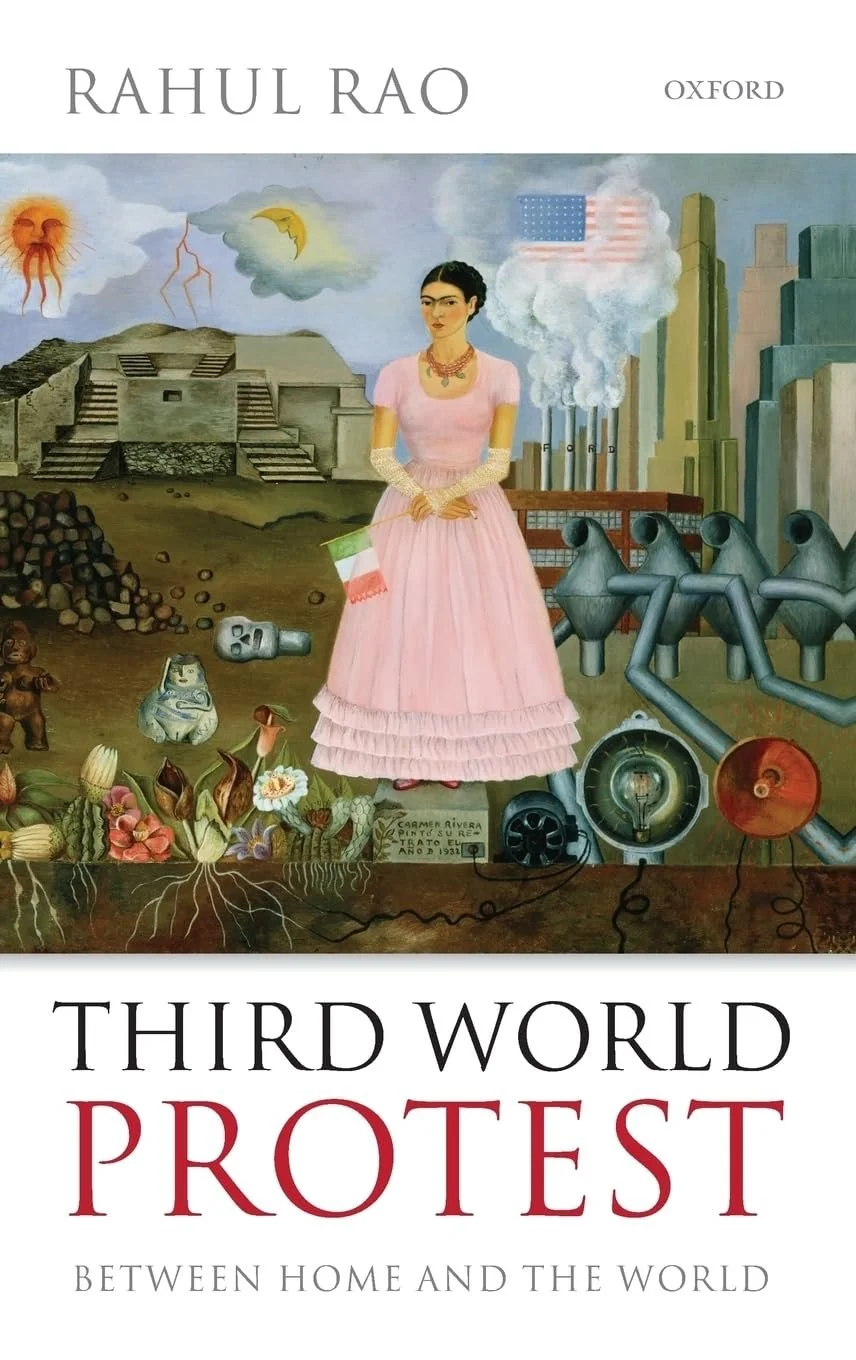
If attitudes towards boundaries are premised on the idea that they protect us from threats, how should we think about the boundaries of states in a world where threats to human rights emanate from both outside the state and the state itself? In Third World Protest, Rahul Rao explores two major normative orientations towards boundaries – cosmopolitanism and nationalism – revealing that hegemonic versions of both are underpinned by simplistic imaginaries of threat. In the cosmopolitan gaze, crisis in the Third World is attributed mainly to domestic factors with the international playing the role of heroic saviour. In the Third World nationalist imaginary, the international is a realm of neo-imperialist predation against which the state is a bulwark. Both images capture widely held intuitions about the locus of threats to human rights, but each by itself provides a partial inventory of these threats.
The book argues that protest sensibilities in the current conjuncture must be critical of hegemonic variants of both cosmopolitanism and nationalism. Journeying through the work of anticolonial writers such as James Joyce, Rabindranath Tagore, Edward Said and Frantz Fanon, the activism of antiglobalisation protesters, and the dilemmas of queer activists in the global South, Rao demonstrates that vital currents of Third World protest have long battled simultaneously against the international and the domestic in a manner that combines nationalist and cosmopolitan sensibilities.
‘This is a fascinating and nuanced book, and one that prompted a range of responses to its core arguments as I read it. It addresses issues that are at the heart of contemporary debates about social movements and popular mobilization in our contemporary globalized environment. It deserves to be read and debated by both researchers and students alike’
— John Solomos, Ethnic and Racial Studies
‘Rao presents us with a way of thinking about international normative theory that deserves to have a major and fundamental impact far beyond the sum of the book’s individual parts. It is his methodological focus on Third World populations and movements as a source for thinking pragmatically about ethics that is so new, and so long-awaited ... highly recommended, indeed compulsory reading’
— Musab Younis, Ceasefire
‘This timely, nuanced and beautifully written book ... should be widely read by historians and theorists of nations and nationalism and all those concerned with the problems of identity, solidarity and political action in the contemporary world’
— Michael Collins, Nations and Nationalism